
The Philippine Social Media Landscape
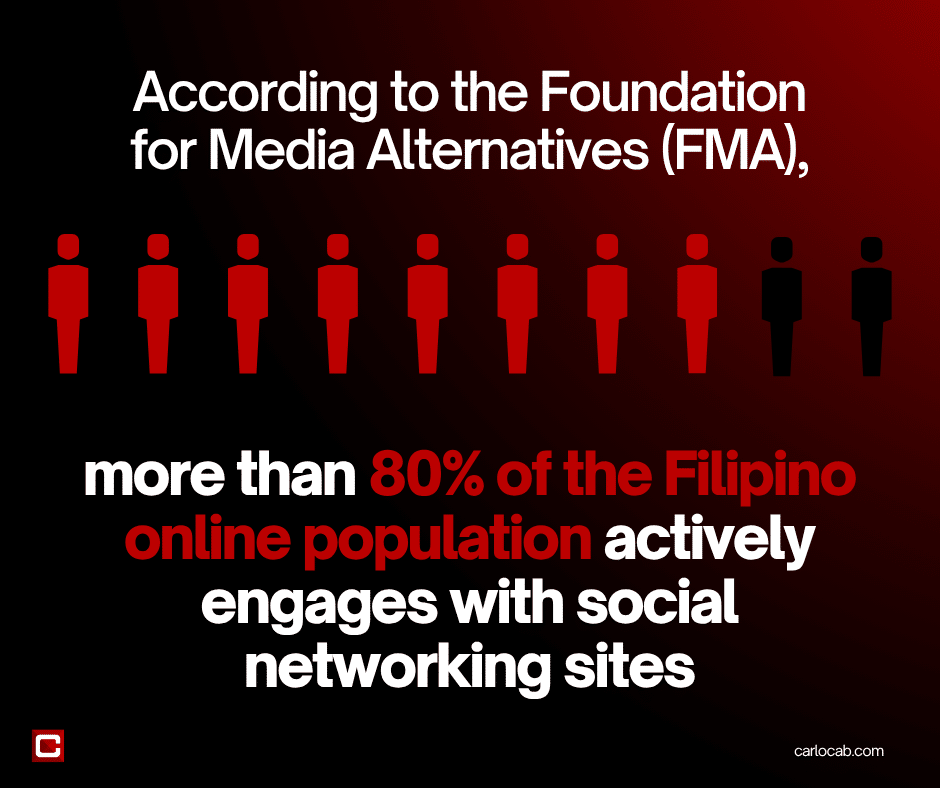
The Philippines is often characterized as a “networked culture” where social media platforms function as the primary gateway to the internet for a vast majority of users. According to the Foundation for Media Alternatives (FMA), more than 80% of the Filipino online population actively engages with social networking sites, with Facebook maintaining a dominant 92% penetration rate (Brutas, n.d.). This high level of connectivity has transformed people’s communication into an “always available” mode, making the archipelago a global leader in digital engagement.
However, this extensive digital integration poses some complex socio-economic and ethical challenges. Research indicates that Filipino influencers often employ “performative authenticity” to bridge the linguistic and class divides between creators and their diverse local audiences (Shtern, Hill, & Chan, 2019).
While social media platforms offer spaces for community building, they also raise significant concerns regarding data privacy and the commodification of audiences. As the shift to digital increases, the tension between maintaining personal privacy and navigating the commercial demands of the social media entertainment industry remains a critical focal point for national discourse.
The Rise of Social Media Integration with Marketing
In the contemporary Philippine digital landscape, social media has transcended its original purpose as a tool for human connectivity to become the focal point of the country’s commercial ecosystem. This integration is not merely a shift in advertising placement but a vital restructuring of how Filipino consumers discover, evaluate, and purchase products. As of 2026, the convergence of social engagement and digital commerce has reached a point of near-total synergy, driven by a mobile-first population and a cultural preference for relational transactions.
From Connectivity to Commerce
The transition from a communication-centric model to a marketing-led ecosystem is best evidenced by the skyrocket in the Philippine digital economy. According to the e-Conomy SEA 2025 Report (Manila Bulletin, 2025), the country’s digital Gross Merchandise Value (GMV) is on a steady trajectory to reach $36 billion by the end of 2025, with a 16% year-on-year growth rate. Social media platforms act as the primary catalyst for this surge, with 42.5% of consumers identifying social media advertisements as their leading source of brand discovery (Meltwater, 2025).
The shift is characterized by the rise of video commerce—a high-volume, low-cost market segment that saw a 90% increase in active sellers between 2024 and 2025 (Manila Bulletin, 2025). Social media platforms like TikTok and Facebook have effectively turned scrolling into shopping by integrating e-commerce like TikTok Shop and Facebook Marketplace, with seamless checkout features directly within the social feed. By 2026, over 56% of Filipinos are making at least one online purchase weekly, totaling an estimated annual spend of $8.24 billion in key sectors such as electronics and fashion (Meltwater, 2025).
Social Media as the New Search Engine for Buyers
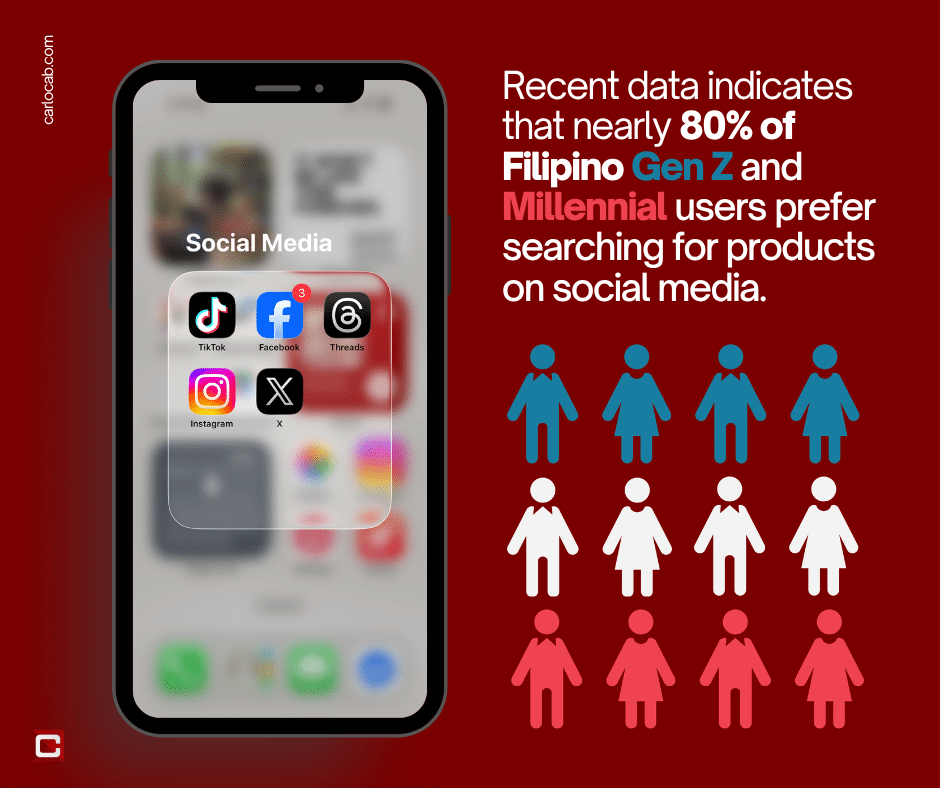
One of the most significant shifts in consumer behavior between 2024 and 2026 is the displacement of traditional search engines by social media platforms. For the modern Filipino buyer, the journey for product information often begins on TikTok or Instagram rather than Google. Recent data indicates that nearly 80% of Filipino Gen Z and Millennial users prefer searching for products on social media because the results are perceived as more visual, relatable, and current.
This trend links to what researchers describe as “performative authenticity” (Shtern, Hill, & Chan, 2019). When users search for a product on social media, they are not just looking for technical specifications; they are looking for human validation. The social search experience allows buyers to see products in real-life contexts through short-form videos, reviews, and user-generated content. This visual evidence acts as a powerful trust signal.
The Algorithm-Driven Discovery Path
The transition to social media as a search engine is further accelerated by AI-driven recommendation algorithms. Rather than the user actively typing a query, platforms now “push” relevant products to users based on their engagement habits. In the Philippines, there is a high level of AI curiosity, with 94% of Filipinos expressing a willingness to share data with AI agents if it results in better personalization (Manila Bulletin, 2025). This data-sharing creates a highly efficient discovery path where each platform anticipates the buyer’s needs.
Social Media Marketing Tactics and Trends in the Post-Pandemic Era
The landscape of social media marketing in the Philippines has shifted permanently since the pandemic. People are no longer just scrolling, but going on livestreams, shopping, and building communities in digital spaces. Businesses have moved away from hard-selling and toward building real connections.
Short-Form Video
The era of long, polished commercials is fading. Filipino consumers now prefer bite-sized, raw video content on platforms like TikTok and Instagram Reels. These quick videos feel more human and less like a scripted advertisement. According to Kpability (2025), short-form video is the most effective way for local brands to capture attention in a fast-paced digital economy.
Influencers as Trusted Peers
The “Influencer Economy” has seen significant maturity into a system of trust. Instead of big stars, brands are leaning toward hiring micro-influencers who feel like real friends. This works because these creators use “performative authenticity” to stay relatable to their followers (Shtern, Hill, & Chan, 2019). And when an influencer shares a product, it feels more like a personal recommendation rather than a paid ad.
Shopping Inside the Social Media App
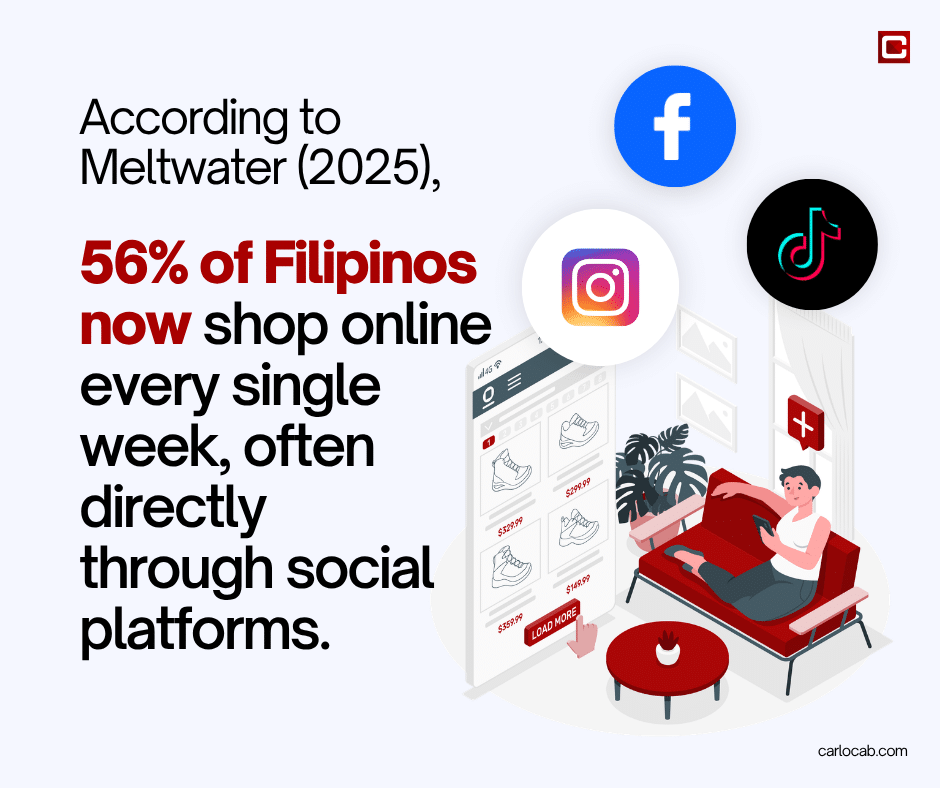
Social commerce is the biggest trend in the post-pandemic Philippines. Users no longer want to switch between apps and websites just to buy something. Features like TikTok Shop and Facebook Marketplace allow for one-tap buying. Research shows that 56% of Filipinos now shop online every single week, often directly through social platforms (Meltwater, 2025).
Interactive Live Selling
Live-selling has become a national pastime. It combines entertainment with instant shopping, allowing viewers to ask questions and see products in real-time. This interactive format builds massive trust, which explains why many Filipinos trust social media content for product discovery. It’s basically a digital palengke that never closes.
Best Practices for Social Media Marketing Philippines 2026 & Beyond
As we move toward a budding digital economy, “business as usual” won’t cut it anymore. To win in 2026, brands must stop acting like faceless corporations and start acting like helpful neighbors online.
Search-First Content Strategy
Since more Filipinos now use TikTok and Instagram as search engines, you need to optimize for discovery. Instead of just posting, create videos that answer specific questions your customers are typing. Use clear keywords in your captions and text-on-screen so the algorithm knows exactly who needs to see your helpful advice or product solutions.
Hyper-Local Authenticity
The one-size-fits-all approach is definitely over. Effective brands are now using “Suki-style” marketing. This means treating your online followers like long-time local customers. Whether it’s using generational slang, regional dialects, or referencing local neighborhood trends, showing that you understand the specific daily life of a Filipino user builds a level of trust that a global ad simply cannot match.
AI Integration for Better Service
Don’t use AI just to write boring captions; use it to be more helpful. With more Filipinos open to sharing data for better experiences, use AI tools to provide instant, personalized recommendations in your DMs. When a customer feels like a brand truly gets their style or needs, they are far more likely to stay loyal.
The Future of Social Media Marketing in the Philippines
Looking ahead, the future of social media marketing in the Philippines is all about deeper human connection powered by smarter tech. We are moving away from noisy ads and toward experiences that actually make life easier.
Here is what is on the horizon for 2026 and beyond:
- Virtual Shopping Assistants: Expect AI bots that don’t just reply to inquiries but actually understand your style and suggest the perfect outfit in your DMs.
- Hyper-Local Stories: Brands will stop trying to talk to everyone and start talking to you—using your local slang and celebrating your specific neighborhood vibes.
- The “Quiet” Feed: As we all get a bit tired of the constant noise, “slow” and calming content that actually focuses on wellness and real hobbies will win our hearts.
FAQs
Which social media is most used in the Philippines?
Facebook remains the most used social media platform. It serves as the primary gateway for news, community connection, and even local commerce.
What are the 7 major social media platforms?
The most influential social media platforms in the country currently include Facebook, TikTok, YouTube, Instagram, Messenger, X (formerly Twitter), and WhatsApp. Each serves a unique role in the Filipino digital lifestyle.
Why is social media marketing important?
Social media marketing is vital because the Philippines is a networked culture. This means the majority of the population is online and active on social media. This allows businesses to reach customers where they already spend most of their time.
Ready to Scale Your Brand with Social Media Marketing Philippines?
Navigating the modern Philippine digital economy requires more than just posting; it demands a search-first strategy rooted in authenticity. In today’s highly networked culture where social media is the primary internet gateway, staying relevant means shifting from mere faceless ads to targeted, “Suki-style” digital relationships.
Don’t get lost in the noise. Partner with Carl Ocab Digital Marketing to implement a data-led social media strategy designed for the Filipino market. From mastering short-form video commerce to leveraging AI-driven tools, CODM provides the expertise to turn scrolling into shopping. Contact us today for a comprehensive social media audit and start scaling your brand!
References:
Brutas, K. (n.d.). Social Media and Privacy: The Philippine Experience. Foundation for Media Alternatives (FMA). Referenced from: https://fma.ph/resources/resources-gender-ict/social-media-and-privacy-the-philippine-experience/
Kpability (2025). Social Media Marketing in the Philippines: Strategy and Trends. Referenced from: https://kpability.com/social-media-marketing-in-the-philippines/
Manila Bulletin (2025). Philippine Digital Economy Surges On, Driving 16% Growth Towards $36 Billion GMV by 2025. Referenced from: https://mb.com.ph/2025/11/25/philippine-digital-economy-surges-on-driving-16-growth-towards-36-billion-gmv-by-2025
Meltwater & We Are Social (2026). Digital 2026: Philippines Report. Referenced from: https://www.meltwater.com/en/global-digital-trends | https://www.sunstar.com.ph/cebu/filipinos-lead-in-social-streaming-digital-spend#:~:text=Over%20half%20of%20Filipino%20consumers,transactions%2C%20outpacing%20traditional%20card%20payments.
Marie, A. (2024). Impact of Social Media Marketing on Consumers in Philippines. ResearchGate. Referenced from: https://www.researchgate.net/publication/385128744_Impact_of_Social_Media_Marketing_on_Consumers_in_Philippines
Ramos & De Castro (2025). The Influence of Social Media Exposure on Consumer Behavior. Journal of Economics, Management and Trade (JEMT). Referenced from: https://journaljemt.com/index.php/JEMT/article/view/1300/2667
Shtern, J., Hill, S., & Chan, D. (2019). Social Media Influence: Performative Authenticity and the Relational Work of Audience Commodification in the Philippines. International Journal of Communication. Referenced from: https://www.researchgate.net/publication/356441489_Social_Media_Influence_Performative_Authenticity_and_the_Relational_Work_of_Audience_Commodification_in_the_Philippines